
Anchor rode calculator
How much anchor chain should you let out? The calculator gives a quick, indicative answer based on water depth, freeboard, tide and the chosen scope. Pick your rode type and conditions and get the recommended length of chain or rope instantly.
Tool
Anchor rode calculator — how much chain and rope to let out
Scope-based calculation with freeboard, tide and chain/rope choice. Live — the result updates with every input.
How we calculate: Effective depth = water depth + tide rise + bow-roller height. Recommended length = effective depth × chosen scope.
This is a rule-of-thumb guide. Bottom type, anchor type, boat windage, current, waves and how well the anchor is set cannot be captured in a simple length calculation.
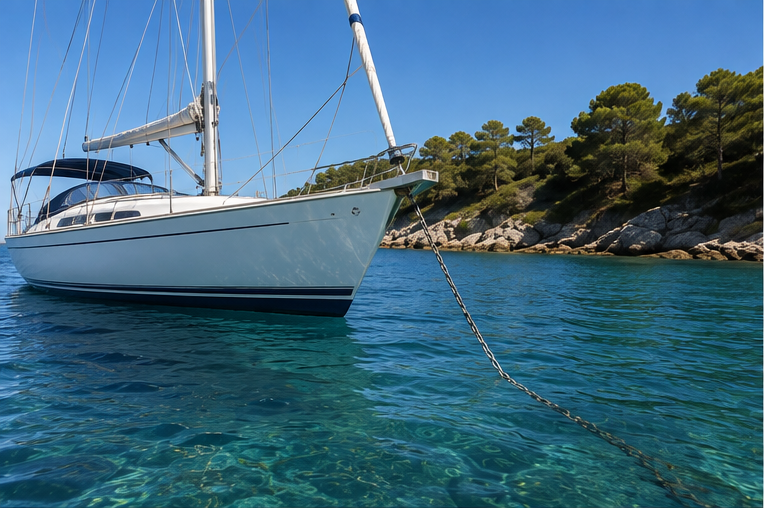
When you anchor, it is not enough for the anchor to reach the seabed. The anchor has to set properly, and the pull from the boat needs to be as horizontal as possible. That is why the length of the anchor chain or anchor rope matters so much. Pay out too little and the pull becomes steeper, the anchor gets poorer working conditions, and the risk that it drags or ploughs through the seabed rises. Pay out more and the angle flattens, loads are absorbed better, and the anchor can normally develop a greater share of its holding power.
NorDok's anchor rode calculator helps you work out a rule-of-thumb length of chain, rope or a combination of the two. The calculation is based on scope: the deployed length divided by the vertical distance from the bow roller on the boat down to the seabed.
It is a simple model, but a practical one. Its biggest strength is that it accounts for more than just the water depth. The height from the waterline to the bow roller and any expected tide rise are included as well. That gives a more realistic starting point than simply multiplying the depth-sounder reading by a fixed number.
The calculator cannot replace seamanship, though. The result must always be weighed against weather, current, seabed conditions, room in the anchorage, other boats, the type and size of anchor, the boat's windage and the expected duration of the stay.
The short rule
The basic calculation is:
Total height to the seabed = water depth + expected tide rise + height of the bow roller above the water
Recommended deployed length = total height to the seabed × chosen scope ratio
Example: water depth 4 metres, expected tide rise 0.5 metres, bow roller 1 metre above the water, scope 5:1. Total height becomes 4 + 0.5 + 1 = 5.5 metres. At 5:1 the indicative deployed length is 5.5 × 5 = 27.5 metres. The calculator can then round the result to a practical figure.
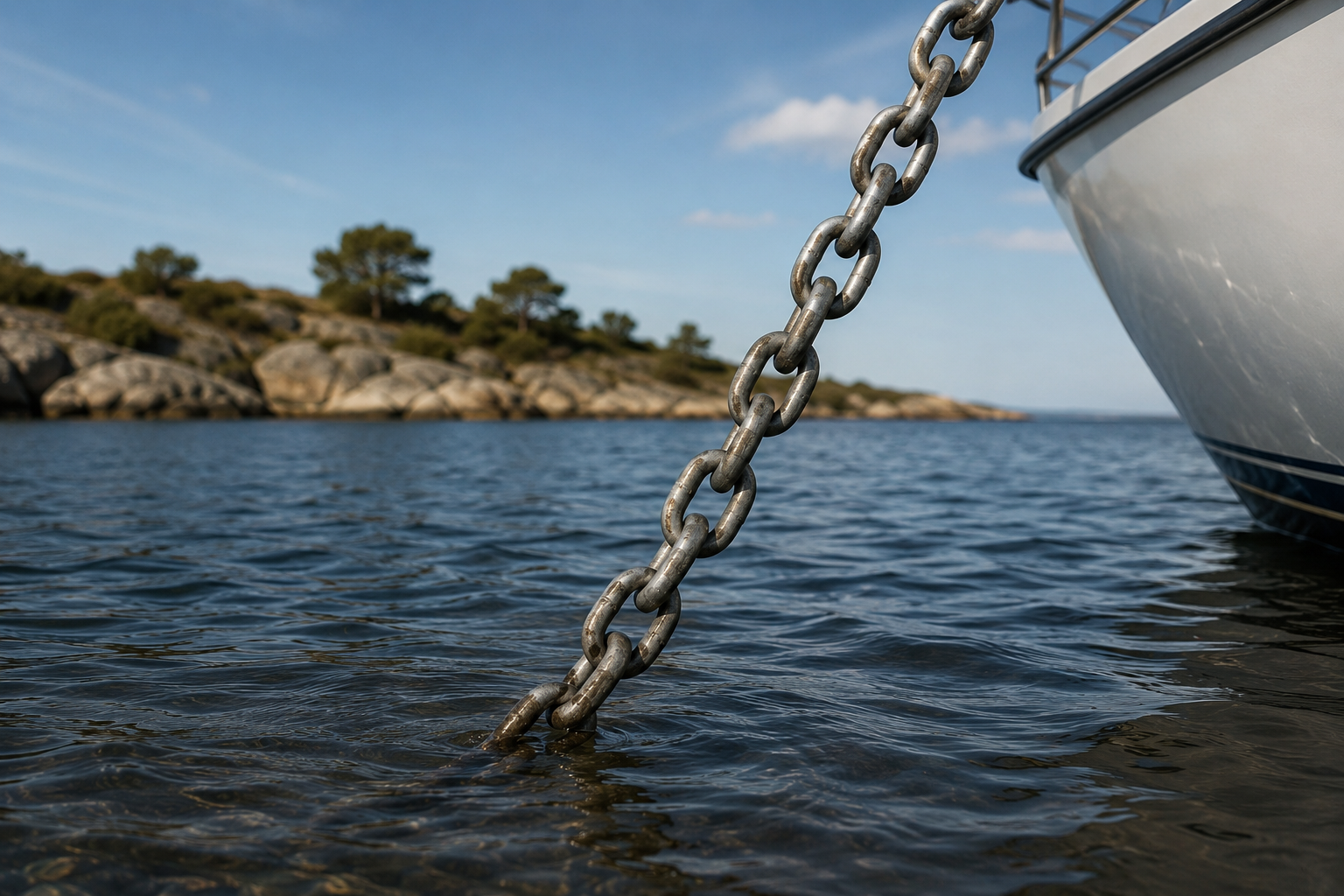
What does scope mean?
Scope is the ratio between the deployed length of anchor gear and the vertical distance from the bow roller to the seabed. A scope of 5:1 means you pay out five metres of chain or rope for every metre from the bow roller down to the bottom.
If the total height is six metres, that works out as: 3:1 = 18 metres, 4:1 = 24 metres, 5:1 = 30 metres, 7:1 = 42 metres, 10:1 = 60 metres.
It is important to understand that scope does not directly tell you the angle of the chain or rope down at the anchor. A heavy chain normally forms a curve — a catenary — between the boat and the anchor, but that curve flattens out as wind and load increase. In heavy weather the chain can lift off the bottom and approach a straighter line. The pull angle at the anchor grows, and the chain's own damping effect is reduced. Scope is therefore a useful rule of thumb, but it is not a complete physical model of the anchor system.
Why should freeboard be included?
A common mistake is to take the water depth and simply multiply by five or seven. That can give too little chain, because the anchor rode does not start at the waterline. It starts at the boat's bow roller, anchor fitting, bollard or chain pipe.
If there is four metres of water and the bow roller sits one metre above the water, the relevant vertical height is five metres. At scope 5:1 the difference is significant: water depth alone gives 4 × 5 = 20 metres, while the correct total height gives 5 × 5 = 25 metres. In this example there are five metres missing if the freeboard is forgotten.
On small boats the height may be modest, but on motor cruisers, catamarans and boats with a high bow the bow roller can sit well above the water. In shallow water the freeboard makes up a large share of the total height, so it should never be overlooked.
Why should tide and water level be included?
The water depth can change while the boat lies at anchor. In areas with tides this is obvious, but even in Danish waters wind set-up, air pressure, current and local conditions can shift the water level.
If you anchor at low water and the level later rises, the distance from the boat to the seabed grows. The chain that gave a suitable scope on arrival can therefore give a smaller scope later. Suppose you anchor in four metres of water with one metre of freeboard: with no tide rise 4 + 1 = 5 metres, with a 1.2 metre rise 4 + 1.2 + 1 = 6.2 metres. At scope 5:1 the requirement shifts from 25 metres to 31 metres — a difference of six metres.
When you enter tide rise into the calculator, you should use the highest expected water level during the stay — not just the level at the moment the anchor goes down.
Which scope should you choose?
There is no single ratio that is always right. The choice depends on ground tackle, conditions and purpose.
Scope 3:1
A ratio of 3:1 can be relevant for a short stop in very calm weather, on good holding ground and under constant watch. It is also used in tight anchorages where there is no room for more swing. It should be regarded as a compromise. The pull angle becomes steeper and the safety margin is smaller. It is normally not the best choice for overnighting or for conditions that could deteriorate.
Scope 4:1
4:1 can be a practical minimum with all-chain rode in sheltered water and moderate conditions. The chain's weight helps keep the pull flat at lighter loads. With rope only or a short chain leader, 4:1 will often be too little, especially if the wind picks up.
Scope 5:1
5:1 is a widely used rule of thumb for ordinary anchoring in fair weather. It typically gives a better pull angle and more margin than 3:1 or 4:1. For many leisure sailors 5:1 is a sensible starting point when the weather is stable, the seabed is suitable and there is enough room.
Scope 7:1
7:1 is often used in fresher winds, when overnighting or when extra safety is wanted. The greater scope normally gives a flatter pull angle and can increase the anchor's effective holding power. With anchor rope or a combined chain-and-rope rode, 7:1 is often more relevant than with all-chain, because rope does not have the same weight as chain.
Scope 10:1
10:1 is typically associated with heavy weather, rope-only rodes or the need for a large safety margin. It requires plenty of room, and the boat's swing radius becomes large. In a gale or heavy seas a big scope is not necessarily enough on its own. Anchor, chain, rope, fittings, snubber and attachments all have to be up to the loads. It may also be necessary to choose a better-sheltered anchorage, use extra ground tackle or forgo anchoring altogether.
All-chain, combination or anchor rope
The anchor gear affects how loads are transferred from the boat to the anchor.
All anchor chain
All-chain is hard-wearing and tolerates contact with rocks, mussels and the seabed better than rope. The weight of the chain helps to keep the pull more horizontal at light and moderate loads. The hanging catenary can also dampen smaller movements. But chain is not elastic. When the wind rises and the chain stretches out, a large part of that damping disappears. Loads from waves and snatch loads can therefore transmit hard into the anchor, windlass, chain stopper and the boat's structure. With all-chain you should normally use an elastic snubber. The snubber relieves the windlass and dampens dynamic loads.
Chain and anchor rope
A combination normally consists of a length of chain near the anchor and rope running up to the boat. The chain protects against chafe at the bottom and helps keep the pull flat. The rope adds elasticity and lower weight. The combination can work very effectively, but it usually needs a larger scope than all-chain. If the chain section is short, the system behaves more like rope-only than all-chain in practice.
The calculator can be used to determine the total length needed. The available chain can be paid out first, with the rest made up of rope. If the calculation shows 35 metres and you have 10 metres of chain, there should be at least 25 metres of rope out beyond the chain as a baseline.
Rope only
Rope weighs much less than chain and therefore does not lie against the seabed in the same way. To achieve a flat pull angle you normally need a larger scope. The elasticity of rope is an advantage, because it dampens snatch loads. Nylon is often well suited thanks to its stretch, but it must be sized correctly and protected from chafe. With rope only, 5:1 is usually a minimum in fair weather, while 7:1 or more is often a better choice for longer stays or rising wind.
Worked examples
Example 1: A short lunch stop in calm weather
Boat length 8 metres, water depth 3 metres, tide rise 0 metres, bow roller 0.8 metres, scope 4:1. Total height 3 + 0 + 0.8 = 3.8 metres. Anchor gear: 3.8 × 4 = 15.2 metres. A practical result is around 16 metres. Because the stop is short, the weather calm and the crew alert, this may be enough on good sand. The anchor's set should still be checked.
Example 2: Overnighting with all-chain
Boat length 10 metres, water depth 5 metres, expected rise 0.5 metres, bow roller 1.2 metres, scope 7:1. Total height 5 + 0.5 + 1.2 = 6.7 metres. Anchor gear: 6.7 × 7 = 46.9 metres. The result rounds to about 47 or 50 metres, depending on the chain's markings. For an overnight stay you should also check the forecast, the swing radius and whether the anchor is properly dug in.
Example 3: Combination of chain and rope
Water depth 4 metres, rise 0.8 metres, bow roller 1 metre, scope 7:1, available chain 12 metres. Total height 4 + 0.8 + 1 = 5.8 metres. Total length 5.8 × 7 = 40.6 metres. If you pay out all 12 metres of chain, roughly 28.6 metres of rope are still needed. In practice you round up, for instance to 12 metres of chain and 30 metres of rope.
Example 4: Anchoring in deeper water
Water depth 12 metres, rise 0.3 metres, bow roller 1.2 metres, scope 5:1. Total height 12 + 0.3 + 1.2 = 13.5 metres. Total length 13.5 × 5 = 67.5 metres. Here the required length is large. You should not only check that you have 68–70 metres of anchor gear, but also whether the swing radius leaves enough room from land, shoals and other boats.
Swing radius and room in the anchorage
More chain or rope means a larger swing radius. The boat can move around the anchor as wind or current shift direction.
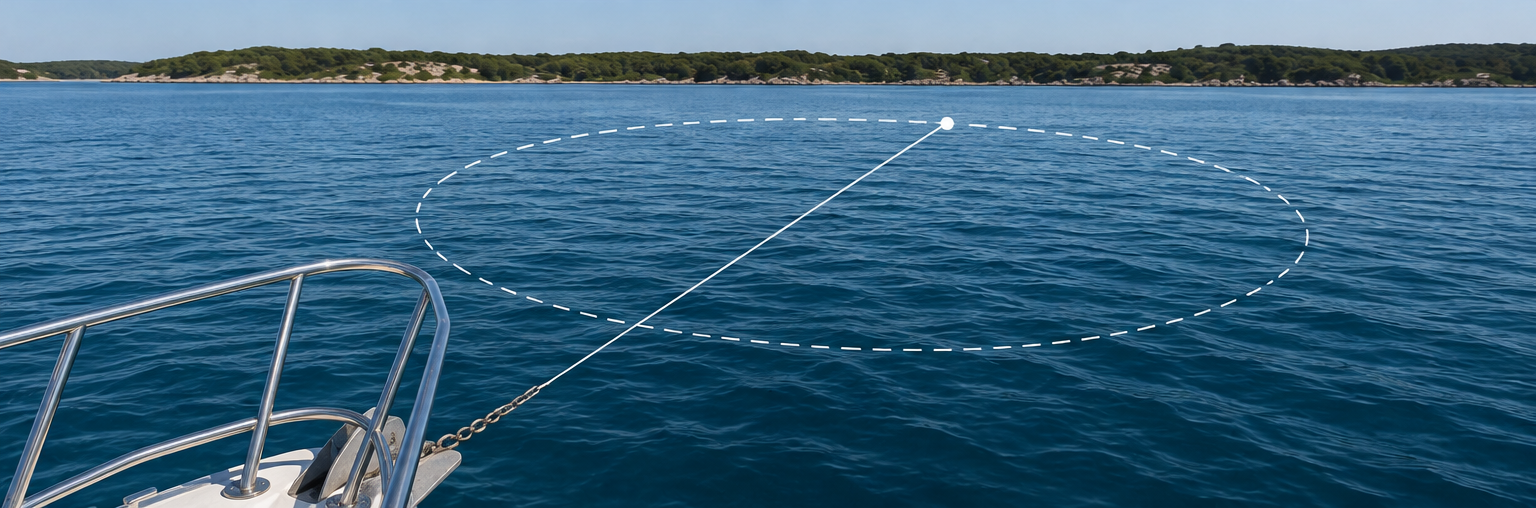
A simple conservative estimate is: swing radius ≈ deployed length + boat length. If you pay out 40 metres from a ten-metre boat, the outermost part of the boat can move in a radius of about 50 metres from the anchor. That corresponds to a diameter of roughly 100 metres. In practice the movement depends on depth, catenary, wind and current. But the calculation shows why it is not sound to simply pay out more without considering the room available.
Check the distance to other boats and their anchors, to land and jetties, rocks, reefs and shallows, shipping lanes and harbour entrances, cables, pipes and areas where anchoring is prohibited.
The type of seabed matters a great deal
Even the correct length only helps up to a point if the anchor does not match the seabed or fails to set. Sand: firm sand often gives good conditions for modern anchors; the anchor can dig in and develop high holding power when set correctly. Mud: varies a lot — soft mud may require an anchor with a large fluke area and time to bury itself. Clay: can give a good hold, but hard clay can be difficult to penetrate. Grass and weed: vegetation can prevent the anchor from reaching firm ground. Rock and stone: an anchor can wedge mechanically between rocks, but the hold can be unpredictable.
Use charts, cruising guides, local knowledge and your own observations. If the anchor does not set under a controlled load, it should be recovered and set again.
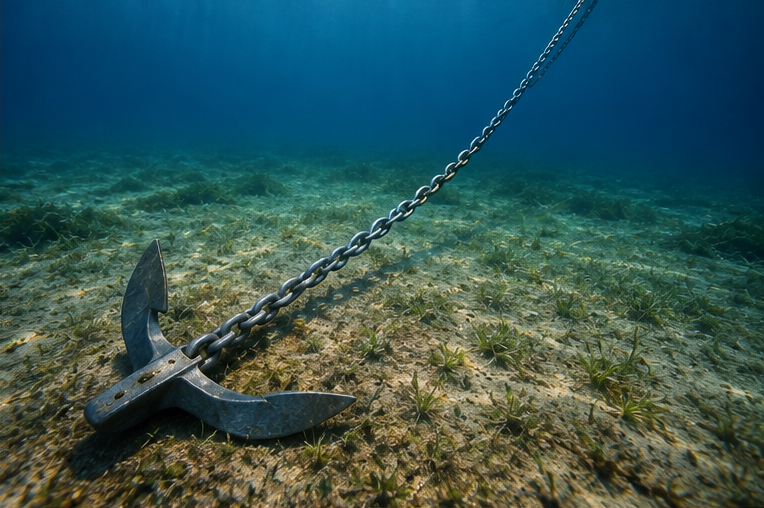
How to set the anchor properly
- Choose your spot and check depth, seabed, shelter and room.
- Ready the anchor and make sure chain or rope can run freely.
- Lower the anchor to the bottom under control. Do not dump it in a heap.
- Reverse slowly while the rode is paid out.
- When the desired length is out, secure the chain or rope properly.
- Increase the load gradually with the engine to dig the anchor in.
- Use fixed transits, the plotter or an anchor alarm to check that the boat is not dragging.
- Check the set again if wind or current changes.
If chain is paid out in a heap on top of the anchor, it can tangle or stop the anchor from orienting itself correctly.
An anchor snubber with all-chain
A snubber is an elastic piece of rope connected to the chain and made fast to the boat's bollards or cleats. When the chain is eased a little, the snubber takes the load. It relieves the windlass, reduces chain noise, dampens snatch loads from wind and waves, cuts peak loads on the anchor and fittings, and provides redundancy when correctly attached.
The snubber has to be long enough to work elastically. A very short piece of rope only gives limited damping. Size and length should match the boat and conditions. The windlass should normally not be the primary load point while lying at anchor — use a chain stopper, a snubber and strong, correctly fitted deck gear.
Windage, boat type and loads
Two boats of the same length can load an anchor very differently. A low sailing yacht and a tall motor cruiser do not present the same windage. A catamaran often has a large beam and surface area, while a heavy, deep-draught boat can move differently in a seaway. Loads rise sharply with wind speed — a modest increase in wind can therefore produce a markedly greater force on the rode.
The calculator does not use the boat's windage to compute a physical load. Boat length can be entered as practical information, but the result is still scope-based. In strong wind, big seas or with a high-sided boat you should choose more conservatively and consider whether the anchorage is suitable at all.
Waves, current and changing direction
Waves can make the boat surge back and forth. These movements create peak loads that are greater than the steady force from the wind alone. All-chain can dampen small movements as long as part of the chain hangs in a curve. Once the chain stretches out, the system becomes stiff. That is why an elastic snubber is particularly important in unsettled weather.
Current can load the boat and change its orientation relative to the wind. When the current turns, the anchor can be pulled from a new direction. Some anchors reset themselves, while others can break out. In tidal areas you should consider the maximum water depth, the strength of the current, the direction after the turn, whether the anchor will reset, and whether the swing circle overlaps other boats.
Typical mistakes when calculating anchor rode
- Using only the water depth — freeboard and tide rise are forgotten.
- Rounding down — a result of 29 metres is rounded to 25 because the chain is marked every five metres. Round up to 30 instead.
- Choosing a low scope because of room — if there is no room for the length required, the anchorage may be the wrong one.
- Trusting chain weight blindly — the chain does not necessarily lie on the bottom in strong wind.
- Forgetting the waves — a sheltered spot in a fresh breeze can be better than an open spot in less wind.
- Not setting the anchor — an anchor that has merely been lowered is not necessarily dug in.
- Making fast directly on the windlass — use suitable load relief.
Chain markings make the calculation usable
A calculation is only useful if you know how much chain is out. Mark the chain with paint, tags or a counter. A simple system can mark every five or ten metres. The scheme should be easy to read in the dark and under pressure. Note what it means near the windlass so everyone on board can use it. Check the markings regularly — paint wears off and plastic tags can fall out.
How much anchor chain should the boat carry?
It depends on sailing area, boat size and use. If you mostly sail in shallow, sheltered Danish waters, the need is different from long-distance cruising in tidal areas. Use the calculator in reverse as a planning tool: enter the largest realistic depth, the expected tide rise, the freeboard and the scope you want to be able to use. The result shows how much anchor gear should be on hand in total.
Example: maximum planned water depth 10 metres, tide rise 1 metre, bow roller 1.2 metres, desired scope 7:1. Total height 12.2 metres, requirement 85.4 metres. That shows that 50 metres of chain is not enough for 7:1 under these assumptions. You can supplement with rope, choose shallower water or accept a smaller scope if conditions allow.
Can you have too much chain out?
More length usually improves the pull angle, but there are practical limits. Too much anchor gear can give a very large swing circle, bring the boat close to other boats or land, increase the risk of crossed anchors, slow recovery and mean that more chain than needed lies on sensitive seabed. Pay out the length the conditions call for and keep enough clearance. "More" is not automatically better if the anchorage is too small.
Anchor alarms and checks after anchoring
An anchor alarm on a plotter, phone or watch can warn you if the boat moves outside a set zone. The alarm should be set with the normal swing circle in mind. An alarm does not replace watchkeeping — GPS positions vary, and the alarm does not always tell you whether the anchor is slowly ploughing. Also use transits to fixed points on land, the depth sounder, distance to other boats, the direction of the chain, the boat's movements and rolling weather updates.
Limits of the calculator
NorDok's tool is a scope-based length calculator. It can work out the geometric rule of thumb, but it cannot predict every force in a real anchoring situation. It does not precisely calculate the anchor's holding power in the actual seabed, wind load on the boat's superstructure, wave peak loads, current forces, the catenary curve of the chain, elasticity in rope and snubber, wear or weakening in equipment, whether the anchor is properly set, or the effects of sailing at anchor. Use the result as a minimum or planning figure, and add a safety margin on top when conditions are uncertain.
Frequently asked questions
How much anchor chain should I pay out?
First work out the height from the bow roller to the seabed: water depth plus freeboard plus expected tide rise. Then multiply by the chosen scope. In fair weather 5:1 is often used, while 7:1 or more may be appropriate for overnighting, rope rodes or fresher wind.
Is water depth enough for the calculation?
No. The height of the bow roller above the water must be included, and so must the highest expected water level during the stay.
What does 5:1 mean?
It means five metres of deployed chain or rope for every metre from the bow roller to the seabed.
Is 3:1 enough?
It can be enough for a short, supervised stop in very calm conditions and on good holding ground. For an overnight stay or in rising wind you should normally use more.
Should anchor chain have a snubber?
With all-chain, an elastic snubber is strongly recommended. It relieves the windlass and reduces shocks from wind and waves.
Why does the anchor hold better with more chain?
More length usually gives a flatter pull angle at the anchor. An anchor typically develops the greatest holding power when it is pulled close to horizontally through the seabed.
How much room does anchoring need?
As a conservative rule of thumb, the swing radius can be estimated as deployed rode plus boat length. Always check other boats, land, shoals and shipping lanes.
What do I do if the calculator shows more chain than I have?
Supplement with rope, choose shallower water or find a better anchorage. Simply ignoring the shortfall is not safe.
Should I round the result up or down?
Round up as a rule. A slightly greater scope gives a better safety margin, if there is room.
Does the same rule work in a storm?
The scope rule is still relevant, but anchoring in a storm takes more than a length calculation. The strength of the gear, the snubber, anchor size, seabed, waves, shelter and alternative plans all become decisive.
Conclusion
The correct length of anchor chain or anchor rope depends first and foremost on the total height from the boat's bow roller to the seabed and on the scope chosen. Water depth alone is not enough — freeboard and expected tide rise must be included.
NorDok's anchor rode calculator makes the sum quick: enter the water depth, add the expected tide rise, add the height of the bow roller above the water, choose a suitable scope, check that you have enough chain and rope, and round up to a practical figure. Treat the result as a rule of thumb. Always weigh up the type of seabed, wind, current, waves, the boat's windage, the size of the anchor and the room the anchorage offers. When in doubt, more safety margin, better shelter or a different anchorage is often the right call.