
Swedish guest harbours ride a strong 2026: more international sailors and booming tourism
Swedish guest harbours are seeing high activity while international tourism in Sweden continues to grow. Here is what the trend means for guest harbours, sailors and maritime tourism across the Nordic region.
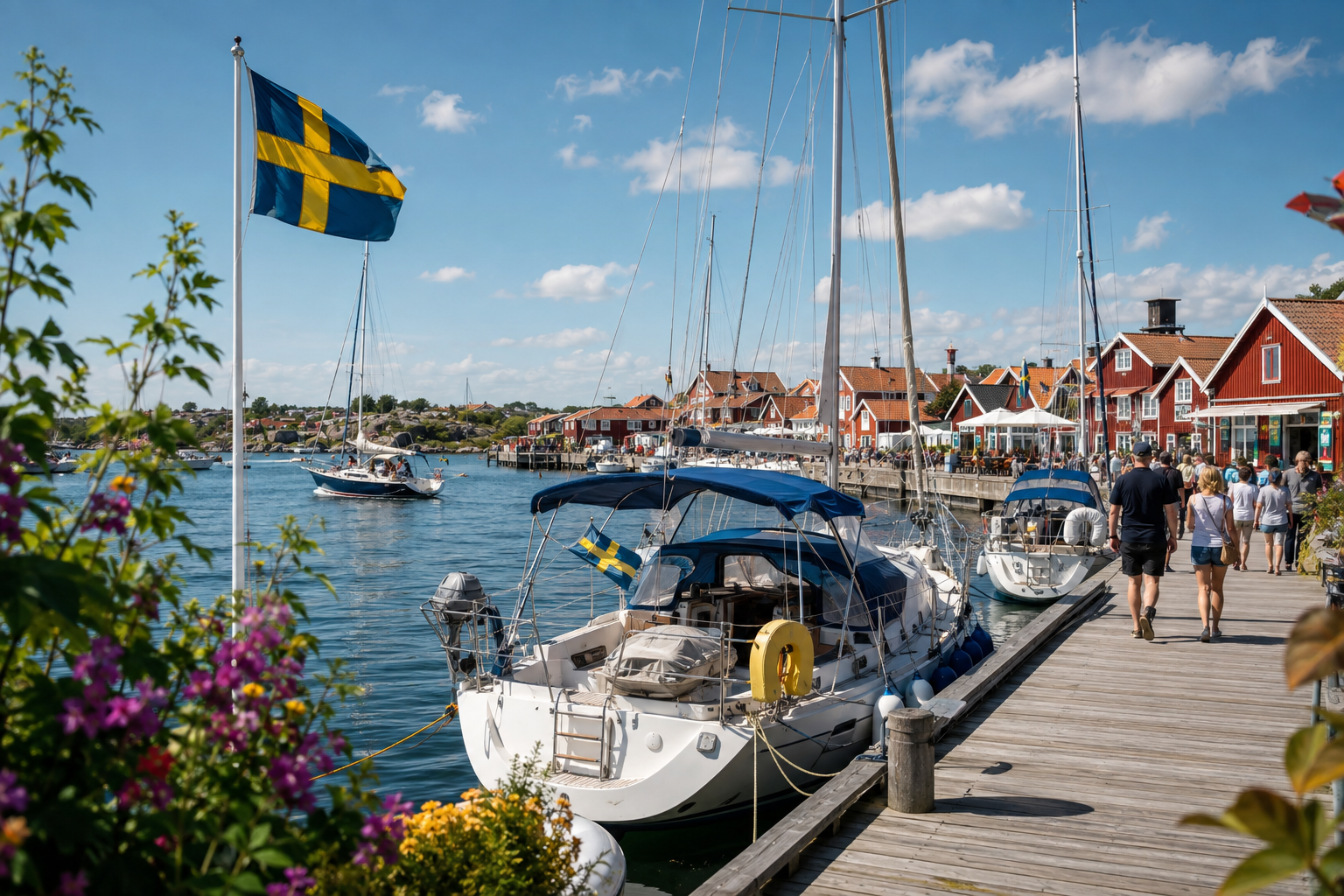
A guest harbour can change character in a matter of hours.
In the morning there are open berths along the pontoon. By late afternoon the boats start arriving from every direction. A German sailing yacht is looking for space along the quay. A Dutch family is making fenders ready. A Norwegian motorboat is hunting for shore power. The last free berths disappear while newcomers circle slowly and weigh up their options.
Days like that are nothing new in Swedish boating. But there is growing evidence that international visitors now make up a larger share of the picture than before.
Sweden is coming straight off a record-breaking tourism year, and the start of 2026 has kept the positive trend going. At the same time, both earlier guest-harbour figures and local examples show that foreign sailors account for a very large proportion of visitors in several Swedish harbours.
That makes the story interesting well beyond Sweden. Boat tourism does not respect municipal borders. A German sailor heading for the Swedish east coast may already have called in at Denmark, Bornholm or the German Baltic coast. A Norwegian boat heading south passes through Swedish waters. And many Swedish boats carry on toward Denmark, Norway, Finland, Åland, Poland and Germany.
A strong Swedish guest-harbour season is therefore also a signal about a larger Nordic market for boat tourism.
But before we label 2026 a nationwide record summer, one important detail: the official Swedish statistics on commercial guest nights do not include guest harbours. That means hotel, camping and holiday-home figures can document the strong tourism around the harbours, but cannot on their own tell us how many boat-nights are recorded in Sweden's guest harbours.
That makes the trend more interesting — and at the same time makes it more important to describe it accurately.
1. First: what do we actually know about 2026?
Sweden's tourism sector entered 2026 from a historically high level. Tillväxtverket put the summer of 2025 at 30.8 million guest nights at commercial accommodation providers in June, July and August. That was around one million more guest nights than the year before, and the highest summer volume in the statistical record.
International visitors grew faster than the market as a whole. They accounted for roughly 9.4 million guest nights over the summer months — an increase of 8.8 percent on the year before.
Västra Götaland, which covers a large part of Sweden's west coast and Bohuslän, was the country's largest summer region with around 5.5 million registered guest nights.
The trend did not stop at the turn of the year. In June 2026 Sveriges Radio reported, citing figures from Tillväxtverket, that Sweden had picked up more than 340,000 additional guest nights from January to April compared with the same period the year before. International interest was also linked in part to the growing "Scandi Summer" trend — the appetite for travelling to cooler Nordic destinations, nature and light summer nights.
That does not by itself document a record in the guest harbours. But it does document that guest harbours are operating in the middle of a tourist economy in which both Sweden as a whole and several coastal destinations are experiencing strong demand.
2. Guest harbours are a blind spot in the official tourism statistics
When newspapers write about millions of Swedish guest nights, it is easy to assume every kind of overnight stay is included. It is not.
Tillväxtverket's official accommodation statistics cover, among other things, hotels, camping sites, hostels, cabin villages and commercially brokered private houses and flats. The boat in the guest harbour falls outside.
Region Kalmar made precisely that point in connection with the record-high visitor numbers for 2025. The region reached almost 3.4 million registered guest nights, but stressed at the same time that the actual number of visitors is larger, because guest harbours among others are not part of the standard statistics.
That is worth remembering when the trend in boat tourism is being assessed. A guest harbour can have an unusually strong season without it being directly visible in the national overnight figures.
The industry's own data, harbour registrations and local surveys are therefore crucial. Riksföreningen Gästhamnar Sverige is actively working to collect relevant statistics from the guest-harbour sector and represents a large share of the Swedish guest harbours.
3. Kalmar shows how international boat tourism has already become
Kalmar Gästhamn is a good example of why international visitors matter so much to Swedish guest harbours.
In July 2025, Sveriges Radio reported that roughly seven out of ten boats in the harbour were foreign. Tourism director Stefan Johnson described a growing international trend at the same time, with Germans still the largest overseas group.
This was not a one-off swing. As far back as 2023, Kalmar Gästhamn recorded 6,573 boat-nights between 1 May and 31 August. That was 10.7 percent more than in the same period the year before, and more than 70 percent of the visitors were international. In 2022 Destination Kalmar reported similarly that 67 percent of boat visitors were international, especially from Germany, the Netherlands and Denmark.
When three separate seasons point in the same direction, it starts to look like a structural strength of the destination rather than a lucky summer.
Kalmar is also strategically placed. For a boat following the Swedish east coast, the town is a natural service stop between Blekinge, Öland and onward passage northward. For international sailors it is also a city destination with shops, restaurants, sights, boatyard services and transport options close to the boat.
Kalmar Gästhamn has around 150 berths spread between Ölandshamnen and Slottsfjärden. 150 berths sounds like a lot. But a large harbour can quickly feel small when many boats arrive within the same few hours.
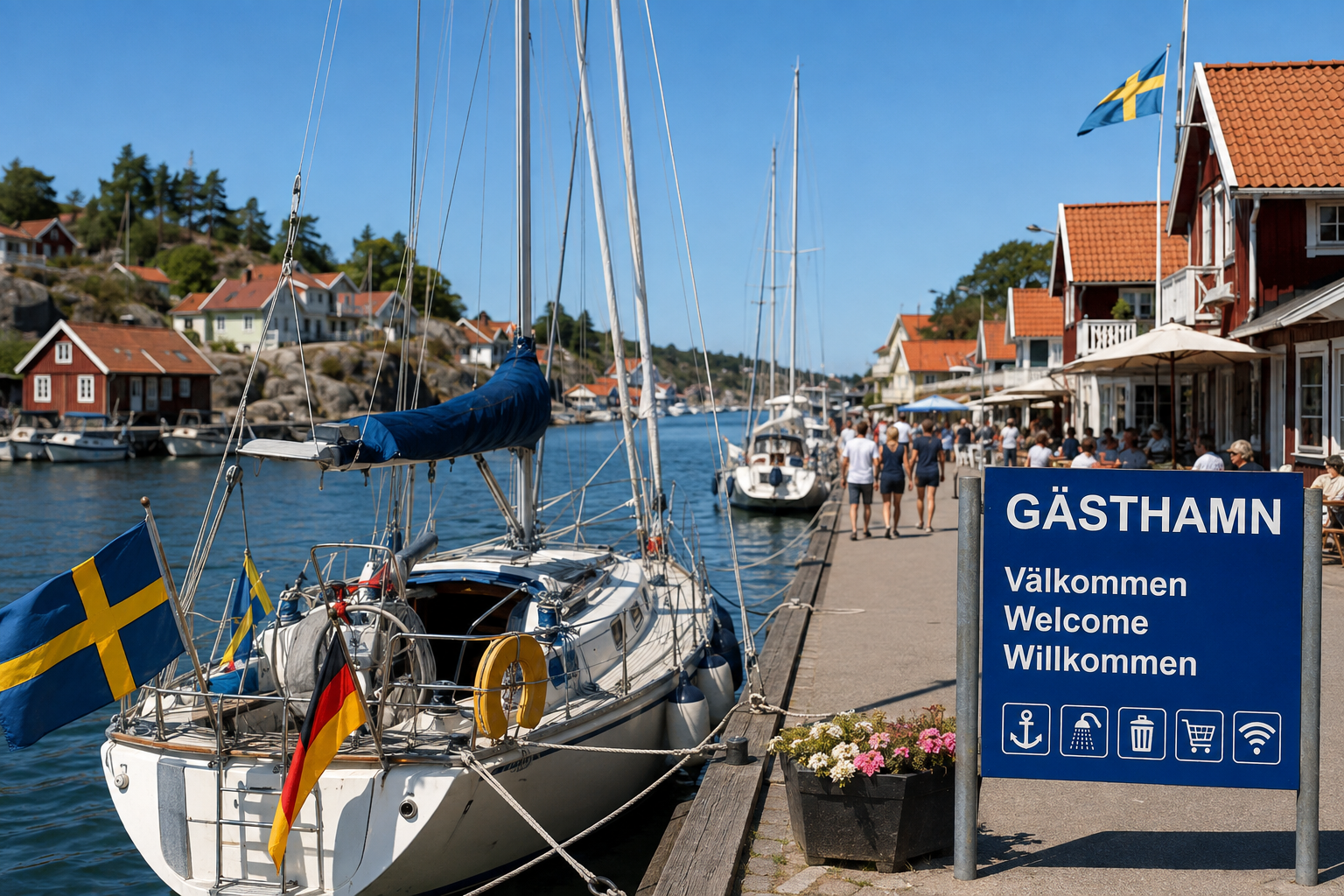
4. Sweden has an unusually strong mix of nature and harbours
The Swedish coast offers something few European destinations can match at the same scale.
On the west coast lies Bohuslän with its rocky islands, small fishing communities and close links to Norway and Denmark. On the east coast are long archipelagos with thousands of islands, sheltered passages and short distances between nature and town. Further south, Skåne, Blekinge, Öland and Gotland act as natural links in Baltic routes between Denmark, Germany, Poland and mainland Sweden.
For many international sailors the boat is also the holiday home. That changes the economics of the trip. Once the boat is in the area, a family can move between harbours and natural anchorages without having to book a hotel every night. The guest harbour becomes the fixed service base along the way instead: showers, power, water, laundry, waste disposal, provisioning and access to experiences ashore.
This combination of nature and functioning infrastructure is a significant competitive advantage.
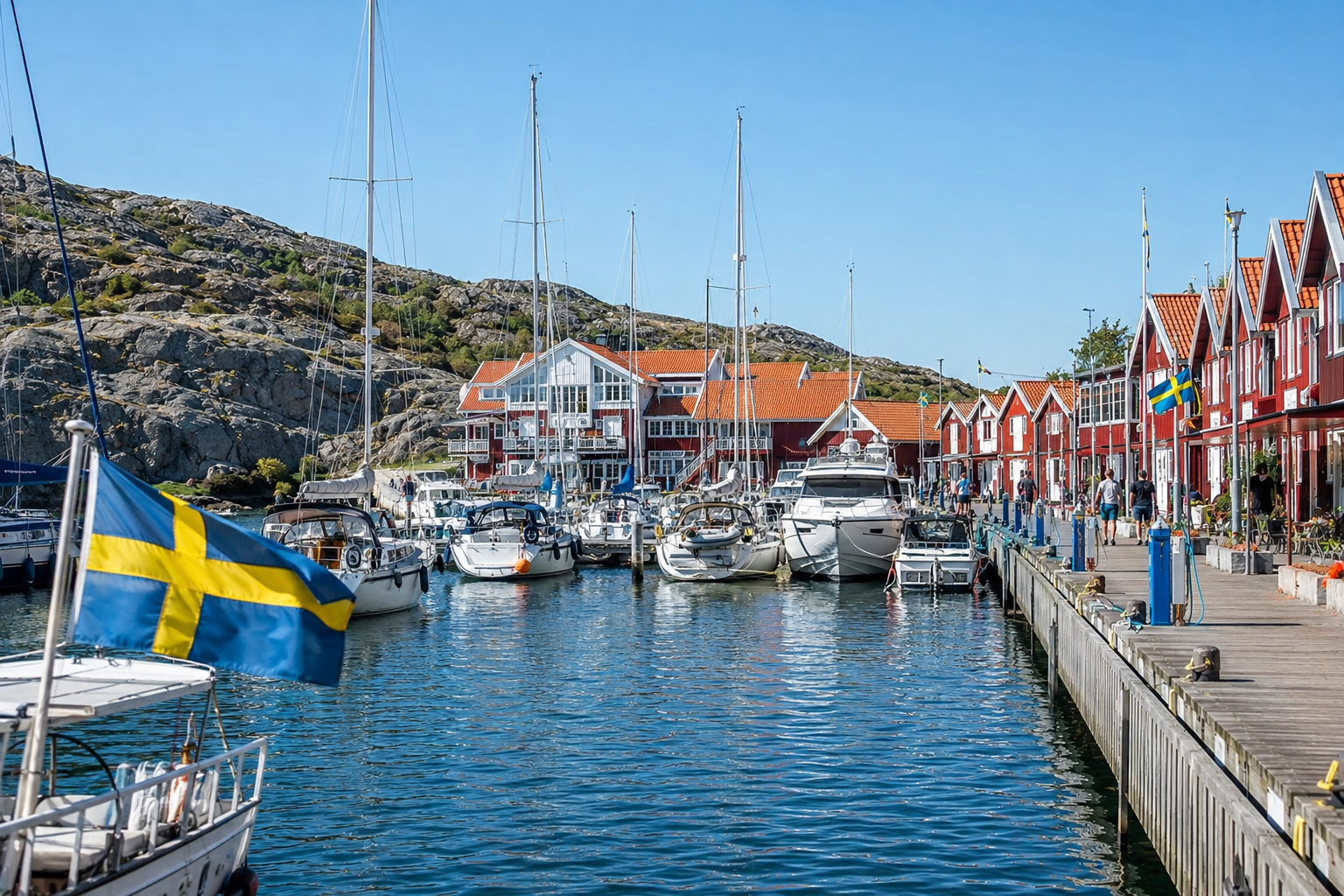
5. Sweden is not one guest harbour — regional differences are large
A strong national tourism season does not mean that every guest harbour posts a record. That is an important nuance. Weather, wind direction, swell, local events, cruising routes and harbour size can shift traffic very quickly.
Orust kommun runs eight guest harbours and reports that together they see around 13,000 guest nights in a summer season. Some of the harbours are major destinations, while others have only around ten visitor berths. Käringön for example has around 125 visitor berths, while smaller harbours such as Henån and Stocken report around ten berths each.
That means two harbours in the same municipality can experience the same summer very differently.
The weather can cut both ways. A period of hard winds can send many boats into port at the same time and produce individual evenings of extreme occupancy. But if bad weather lasts, fewer boats leave home port at all, and the overall season can end up weaker.
A "record summer" should therefore not be judged on whether a popular harbour was full on three Saturdays in July. Boat-nights across the whole season tell a much richer story.
6. International visitors are especially interesting for the destinations
An international boat visitor does not just buy a berth. The crew has to eat, shop and often experience something ashore. There is demand for groceries, restaurant visits, fuel, spare parts, ice, bike hire, museum tickets, transport and perhaps a workshop visit.
Riksföreningen Gästhamnar Sverige has previously estimated that only around a quarter of the value from a guest-harbour overnight stay stays in the harbour itself, while the rest goes to other businesses on the destination. The association has also previously estimated that a significant share of arrivals in Swedish guest harbours comes from foreign boats.
The figures are industry estimates rather than official national-accounts statistics. But the point is well documented at a more general level: tourism creates turnover far beyond the accommodation itself.
For a small coastal town the guest harbour can therefore act as a floating campsite in the middle of the retail area. The difference is that the guest has brought their own accommodation with them.
7. A guest harbour no longer competes on location alone
A beautiful setting still matters. But the service experience matters more when visitors can choose between many destinations.
The modern boat tourist typically expects to find basic information before arrival:
- Is there a free berth?
- What is the depth?
- Can the berth be booked?
- What does an overnight stay cost?
- Is power included?
- Which type of mooring is used?
- Where is the pump-out?
- Are there showers and toilets?
- Can you do laundry?
- How far is it to a grocery shop?
- Can you refuel with diesel or petrol?
- Is there a boatyard or engine service?
- What are the rules for waste?
- Can a large boat get in?
- How do you pay?
Kalmar publishes the number of berths, depth, mooring types, prices, shore-power ratings and services on its official site. Orust's guest harbours are cashless, and several of them use digital solutions for payment and advance booking.
That kind of transparency is no longer a bonus. For a German or Dutch crew planning the next day's leg in the evening, clear digital information can be the difference between the destination being chosen or sailed past.
8. Multilingual information is becoming more important
If international boat tourism keeps growing, guest harbours should think more like tourist destinations and less like local boat clubs.
The local sailor already knows where the diesel pump is. The first-time German visitor does not. The Swedish visitor understands the mooring sign. The Dutch family may not.
For that reason English information in particular is important, and in areas with many German visitors, German can be a genuine service improvement. It is not about translating every single page. What matters is the information that affects the decision and safety:
- approach
- depth
- maximum boat size
- mooring
- payment
- power and water
- reservation
- harbour rules
- waste
- pump-out
- contact in case of trouble
When that information is easily accessible, the harbour becomes simpler to visit.
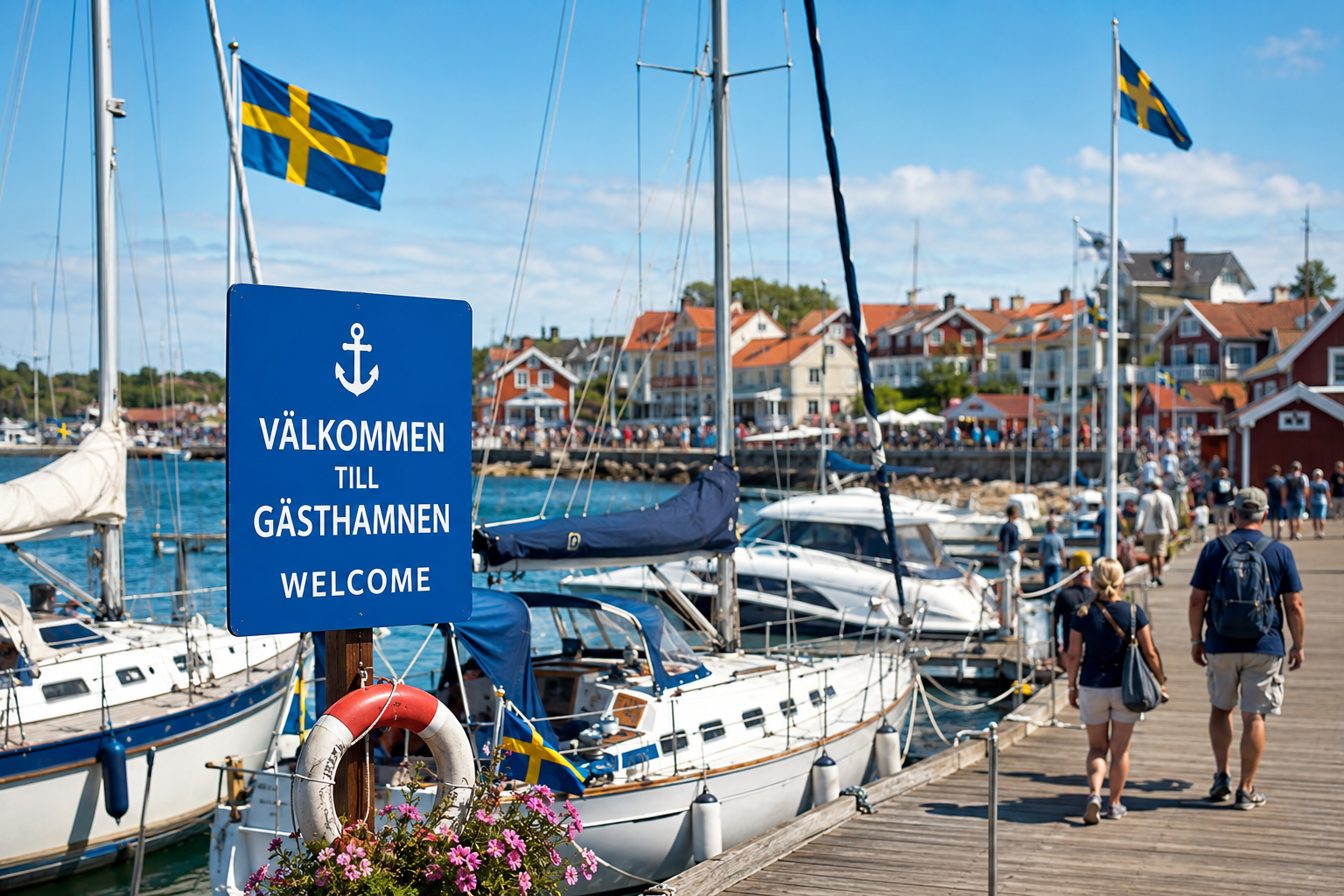
9. Digital booking is changing behaviour
Traditionally, many sailors would motor into a guest harbour and find a free berth. That still happens. But digital booking systems now make it possible to plan further ahead.
There are advantages. A family knows there is a berth after a long leg. The harbour gets a better overview of occupancy. Large boats can be assigned berths that actually fit. And the visitor spends less time circling in a full harbour.
But booking can also create new challenges. A physically empty berth may be reserved for a boat that will only arrive several hours later. Other visitors can experience the harbour as "full" even though there are visually free berths.
Clear signage and good real-time information therefore become even more important. A strong season, in other words, is not only about building more pontoons. It is also about making better use of the existing capacity.
10. Large harbours can also hit their capacity limit
Sweden has many large guest harbours. Kalmar has around 150 berths. Käringön reports around 125. Stavsnäs Vinterhamn east of Stockholm has around 140 visitor berths. These are substantial facilities.
But boat tourism has a particular capacity challenge: not all berths are equal. A 14-metre sailing yacht cannot necessarily use the berth that an eight-metre motorboat has just vacated. Draught, beam, mooring system, power requirements and wind exposure all matter.
The practical capacity may therefore be lower than the number of berths listed on the website. In a strong season, precise data about the berths becomes valuable. Not just "150 berths", but which boat sizes they can take.
11. The guest harbour becomes part of the overall travel experience
The classic notion of a guest harbour is a place where the boat can lie safely overnight. Today the harbour can be much more. It can be the starting point for cycle trips, walking, city visits, restaurants, culture, shopping and attractions.
Kalmar for example works actively with events and activities around the harbour area. On Orust the harbours are part of some of Bohuslän's best-known coastal communities.
That matters, because sailors do not necessarily choose the shortest route. They also choose the most interesting one.
If two harbours lie 15 nautical miles apart, but one has clear information about restaurants, shopping, sauna, playground, nature trails and cycling, it can have a clear edge. That is destination development — just seen from the water.
12. 2026 fits into a wider Swedish tourism trend
The strong interest in Sweden did not appear in one summer. In 2025 the country reached 70.8 million registered guest nights at commercial accommodation providers. That was 2.5 percent more than the year before.
Visit Sweden also points to an interesting long-term shift: overnight stays outside the three classic summer months have grown faster than overnight stays in June, July and August since 2015.
Summer is still the largest continuous season. But the shoulder seasons are growing.
That could become interesting for boat tourism. Modern boats, better foul-weather gear, more accurate forecasts and flexible working lives make it possible for some sailors to set off earlier in the spring or carry on further into September.
For guest harbours this raises a question: when does the service close? A harbour can be physically accessible, but if showers, toilets, shore power, restaurants and the harbour office all close at the same time as the school holidays, it becomes less attractive outside high season.
13. A longer season does not necessarily require full staffing
Extending the season does not mean the harbour needs the same staffing in April as in July. Digital payment, access codes, remote support and automated booking make it possible to offer a basic service with fewer staff.
Some Swedish harbours already work with different service levels through the year. It can be an interesting model:
High season
- full staffing
- daily cleaning several times
- tourist information
- high service
- activities
Shoulder season
- self-service payment
- power and water
- toilets and showers
- limited harbour attendance
- clear emergency and contact information
That way the guest harbour can remain an attractive stop without carrying the full costs of high season.
14. Growth puts more pressure on environmental facilities
More visiting boats also mean more strain. More waste. More waste water. More power consumption. More toilet use. More boats filling water. More manoeuvres in the harbour basin.
That makes capacity in environmental and service facilities just as important as the number of mooring berths. Kalmar offers, among other things, a pump-out and a hull washer, while several of Orust's guest harbours have free pump-out stations for boat holding tanks during the season.
These are facilities that gain importance as traffic grows. A harbour with 100 berths and one hard-to-reach pump-out station can still have a capacity bottleneck.
15. High occupancy is good — but not if the guest has a poor experience
It is tempting to see a full guest harbour as the perfect result. Financially, high occupancy is obviously attractive. But overcrowding can also wear down the experience.
Queues for the shower. Missing power sockets. Overflowing waste containers. Boats rafted awkwardly against each other. Noise. Waiting times at the fuel dock. A shortage of harbour hosts.
If a guest pays for an attractive destination but meets a harbour that feels overloaded and poorly organised, the record visit can become a problem the following year.
Capacity therefore has to be measured by more than the number of hulls that can be squeezed in.
16. What can Danish and Nordic harbours learn?
The Swedish trend is interesting for the whole Nordic region. Denmark, Norway, Sweden, Finland and the German and Polish Baltic coasts do not just compete for the same sailors. They are also dependent on each other. A good experience in one harbour can send a boat on to the next destination.
There are at least ten obvious lessons:
- Make harbour data precise. Depth, length, beam, mooring, number of berths and services should all be up to date.
- Make the information international. At the very least, the most important visitor information should be available in English.
- Show what lies beyond the harbour. Shops, restaurants, attractions, bikes, hiking and public transport are all part of the product.
- Make payment simple. A foreign visitor should not have to depend on a local payment system without explanation.
- Think in terms of actual capacity. Record which boat sizes each berth can take.
- Use booking thoughtfully. Reservations should be visible and understandable to both booking and walk-up visitors.
- Match environmental capacity to boat capacity. Toilets, showers, waste, pump-out and shore power all need to keep pace with visitor numbers.
- Measure the season. Boat-nights, nationality, boat size, length of stay and timing provide a better basis for investment.
- Look at the shoulder season. There may be untapped demand in May, June, August and September.
- Treat the guest harbour as tourism infrastructure. The harbour is the entrance to the town or the area for a well-heeled and mobile group of visitors.
17. Why data is becoming more important
If guest harbours are not fully included in the standard tourism statistics, the industry's own data becomes doubly important. It is hard to make the case for investment in pontoons, sanitation buildings, shore power, environmental stations or marketing if all you can say is: "There were lots of boats in July."
Better data can show:
- number of boat-nights
- average length of stay
- nationalities
- share of advance bookings
- boat sizes
- occupancy per week
- boats turned away on full days
- power consumption
- use of the pump-out
- demand before and after high season
That enables the harbour to invest against real need. For a Nordic harbour guide, precise harbour data is at the same time essential so that the sailor can make the decision before arrival.
18. A strong Swedish season can also be felt in Denmark
Boat tourism works as a network. A German boat heading for the Swedish west coast may pass through Danish waters. A Swedish boat bound for the European Baltic coast may stop at Bornholm or in a south Sjælland harbour. Boats travelling between Norway and Sweden use the Kattegat and the Skagerrak as a shared corridor.
Growth in one country is therefore not necessarily a zero-sum game. More international sailors in the Nordic region can bring more visitors to the whole route.
In return it requires the information to hang together across borders. A sailor rarely thinks "Now I am leaving the Swedish tourism product and entering the Danish one." They think "Where can we lie safely tomorrow night?"
That is the competition the harbours are really in.
19. So is 2026 a record summer for Swedish guest harbours?
The most precise answer right now is: it could be a very strong season, and several indicators point that way — but a nationwide record should only be declared once the guest harbours' own final season figures have been compiled.
The official Swedish accommodation statistics cannot settle the question, because guest harbours are not included as a standard accommodation category.
On the other hand, we already know a number of things:
- Swedish tourism is coming from record levels.
- 2026 began with more guest nights than the year before.
- International tourism is a significant driver.
- Several coastal destinations have seen a high and growing share of foreign visitors over several years.
- In Kalmar, international boats have accounted for around two thirds or more of the guest harbour's visitors over several seasons.
- And Sweden's many guest harbours make up a substantial piece of tourism infrastructure that is not always visible in the standard overnight figures.
That is a story in itself.
Boat tourism deserves to be measured as tourism
When a foreign family sails into Kalmar, Käringön or a small harbour on Orust, their boat may be logged as one boat-night in the harbour's own system. But their economic and touristic footprint does not stop at the mooring line.
They shop. They eat. They refuel. They visit sights. They use services. And they sail on to the next destination.
The strong Swedish tourism performance and the large international share in several guest harbours show why recreational boating should be treated as a genuine part of the Nordic visitor economy.
For the harbours the task is not simply to find room for more boats. It is to make it easy to choose the harbour, easy to arrive, easy to pay and worth staying an extra night.
If boat tourism continues on its positive trajectory, the harbours with the best data and the clearest service can end up in the strongest position. Not necessarily the biggest. But those that best understand the guest on the other side of the gunwale.
Sources and further reading
- Tillväxtverket: Record summer for Sweden's 2025 tourism
- Tillväxtverket: Accommodation statistics 2025
- Sveriges Radio: Tourism year off to a strong start — hundreds of thousands more guest nights
- Visit Sweden: Tourism outside the summer high season is growing fastest
- Region Kalmar län: Record number of guest nights in Kalmar County in 2025
- Sveriges Radio: Seven out of ten boats in the guest harbour are foreign
- Destination Kalmar: Kalmar Gästhamn · Record summer for Kalmar's accommodation providers
- Orust kommun: Guest harbours · Käringön guest harbour
- Värmdö kommun: Stavsnäs Vinterhamn
- Riksföreningen Gästhamnar Sverige: Industry
- Båtliv Sverige
Også relevant ved3
Hjalp denne nyhed? Del den med din sejlerven.